Your website is your 24/7 salesperson. It works weekends, bank holidays, and late nights. It never calls in sick. But ask yourself: if that salesperson looked dishevelled, took 10 seconds to answer a simple question, and couldn't be understood when speaking to someone on a mobile phone, would you keep them employed?
In 2026, user expectations in Ireland are higher than ever. Customers are browsing on the DART, checking prices while walking through Grafton Street, or booking services from their couch in Cork. If your site doesn't perform, they simply click "Back" and go to your competitor.
Here are the definitive, critical signs that your website is overdue for a retirement party—and how a redesign can reignite your business growth.
1. The "Pinch and Zoom" Experience (Mobile Failure)
It is 2026. If a visitor has to pinch their screen to read your text, they are gone.
The Reality:
Over 65% of all web traffic in Ireland now comes from mobile devices. If your website was built for a desktop monitor and "shrinks" to fit a phone (making the text tiny), it is failing the basic usability test.
Why it hurts SEO:
Google now uses Mobile-First Indexing. This means Google only looks at the mobile version of your site to decide where to rank you in search results. If your desktop site looks great but your mobile site is a mess, to Google, your entire website is a mess. You will not rank on page 1.
2. It Fails the "3-Second Rule" (Core Web Vitals)
We live in an age of instant gratification. If your site feels sluggish, users assume your service is sluggish too.
The Metrics:
Google measures user experience using Core Web Vitals. These are specific metrics that judge how fast your site loads, how quickly it becomes interactive, and if the layout "jumps" around while loading.
- 0-2 Seconds: Excellent. Users are happy.
- 2-4 Seconds: Warning zone. You are losing impatient visitors.
- 4+ Seconds: The "Kill Zone." The majority of new visitors will bounce before seeing a single word.
The DIY Test:
Don't guess. Use reliable tools like Google PageSpeed Insights to get the brutal truth about your performance. If you are seeing red scores, it is time for a rebuild.
3. You Are Afraid to Update It
This is a classic problem I see with Irish SMEs. You want to change a price, add a new service, or update a team member's photo—but you don't.
Why?
- "I might break the layout if I touch it."
- "I have to email the developer and wait 2 weeks for a simple text change."
- "I lost the login details years ago."
The Solution:
A modern website comes with a user-friendly Content Management System (CMS)—like WordPress or a headless setup—that makes editing text as easy as sending an email. Your business evolves; your website must be able to keep up instantly. If you can't update your own "News" page, your website is dead.
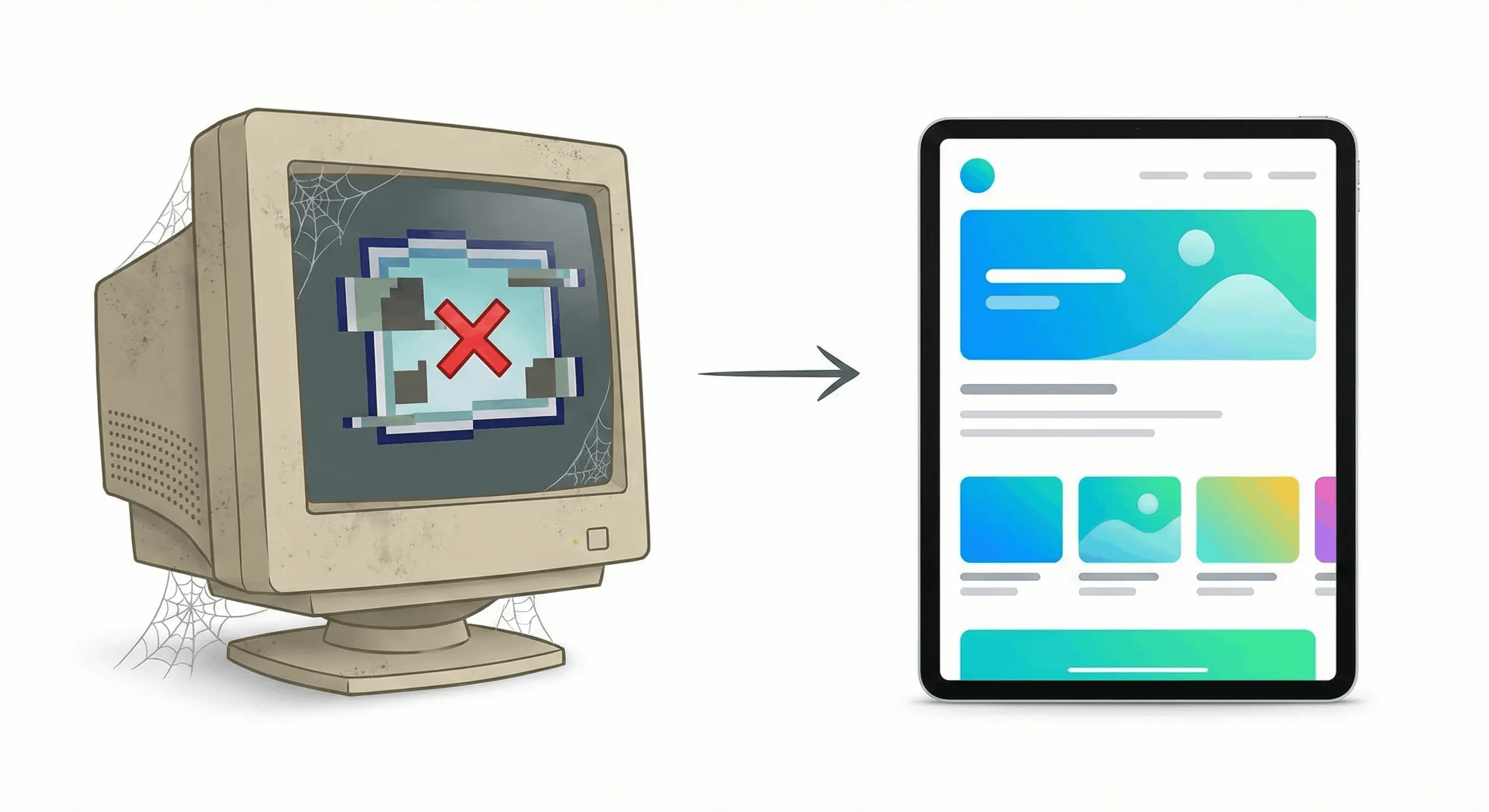
4. It Looks Like 2015 (Design Trust Factors)
Design trends age like milk. What looked "cutting edge" ten years ago now looks suspicious. Studies show that trust is established in 0.05 seconds.
Signs of an outdated design:
- Boxy Layouts: Narrow content columns with huge empty spaces on the sides.
- Stock Photos: Generic, cheesy photos of "people in suits shaking hands" that don't look like your actual team or Irish customers.
- Tiny Fonts: 12px or 14px text that is hard to read on modern high-resolution screens.
- Carousels: Auto-playing sliders that spin too fast (users ignore them).
- The Copyright Date: Seeing "© 2018" in the footer tells customers you might be out of business.
5. You Are Not Getting Enquiries
This is the ultimate metric. Traffic is vanity; conversion is sanity. If you have visitors coming to your site but the phone isn't ringing and the inbox is empty, your website is failing its primary job.
The Conversion Problem:
Often, this isn't just a technical glitch; it is a User Experience (UX) failure.
- Is your phone number clickable? (It should dial immediately when tapped on mobile).
- Is your "Contact Us" form asking for too much info?
- Are you talking about features (what you do) instead of benefits (how you help)?
A redesign focuses on Conversion Rate Optimization (CRO)—structuring the page to guide the user gently toward that "Get a Quote" button.
Bonus: The "Not Secure" Warning
Look at your browser address bar. Do you see a padlock icon, or does it say "Not Secure"?
If your site is missing an SSL Certificate (HTTPS), browsers like Chrome will warn visitors that your site is unsafe. This kills trust immediately. In 2026, security is not optional; it is a requirement for ranking and reputation.
The Solution? Repair or Replace?
Refreshing your website doesn't always mean starting from scratch with a massive budget.
- For simple brochure sites: We can often migrate your content to a modern, fast static site or a clean WordPress build that solves all these problems at once.
- For older complex sites: A rebuild is often cheaper than trying to patch security holes and fix broken code in an old system.
I specialize in turning "legacy" websites into high-performance lead generators for businesses in Dublin and across Ireland.
Get a Free Website Audit Today
Frequently Asked Questions (FAQ)
How often should a business website be redesigned?
On average, every 3-5 years. Technology moves fast. Browsers change, design trends shift, and Google's ranking rules evolve. If your site is 5 years old, it is likely running on obsolete code.
Will I lose my Google ranking if I build a new site?
Not if done correctly. In fact, you should rank higher. When I rebuild a site, I set up "301 Redirects" to ensure all your old links point to your new pages, preserving your SEO history while boosting your score with better speed and mobile design.
Can you fix my site speed without building a new one?
Sometimes. If the site is built on good foundations, we can optimize images and cache settings. However, if the underlying theme is bloated or the code is old, a rebuild is often more cost-effective than hours of troubleshooting.